
AWS Cloud Credit for Research: Student Grants Up to $5,000
Direct Answer: The AWS Cloud Credit for Research program grants accredited undergraduate, master's, and PhD students up to $5,000.00 USD in promotional cloud credits for academic research and thesis execution with a faculty sponsor. The grant covers high-performance EC2 GPU compute (NVIDIA A10G and A100 instances), Amazon Bedrock foundation models (Claude 3.5 Sonnet, Llama 3.3), and S3 scientific storage, awarded via rolling quarterly proposal reviews with zero credit card required.
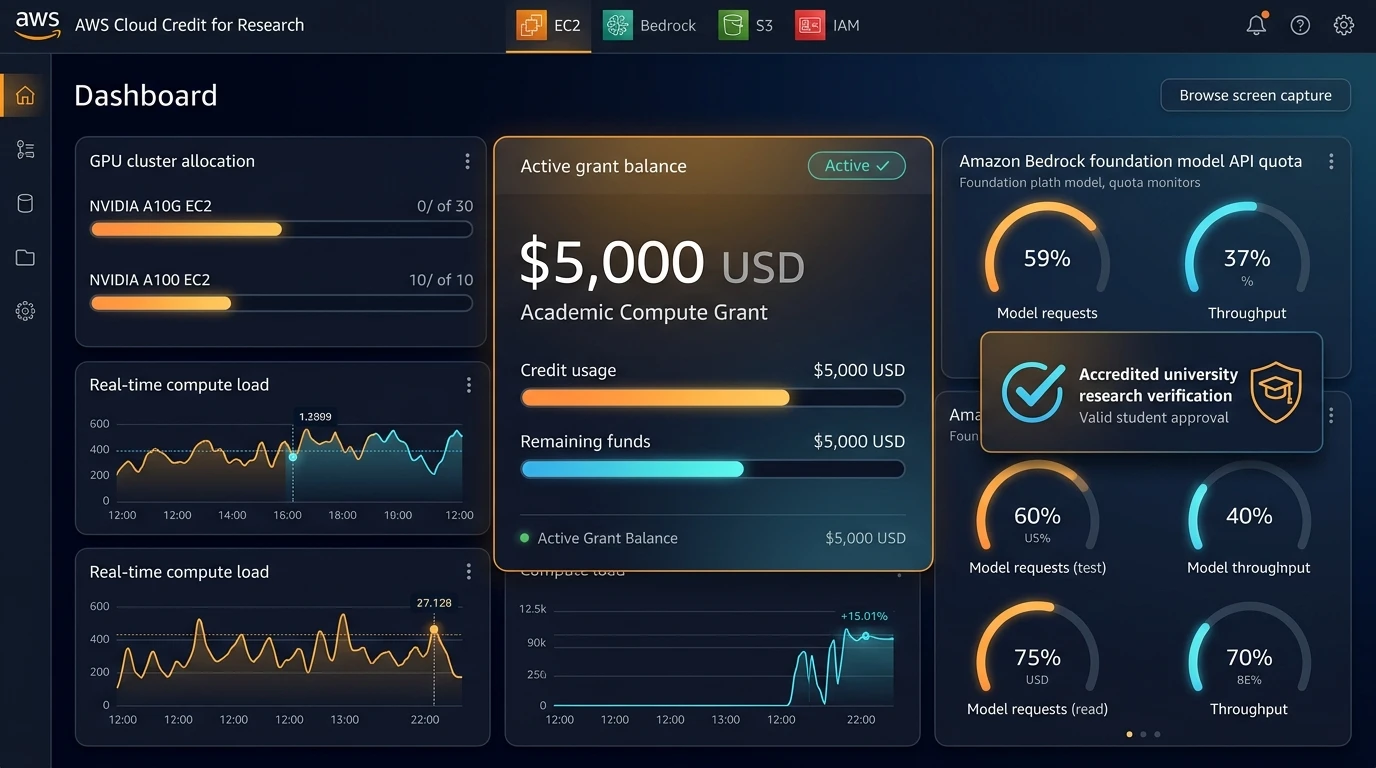
AWS Cloud Credit for Research Sizing Calculator
Calculate your academic compute allocation across NVIDIA A10G/A100 GPU hours, Amazon Bedrock token limits, and review turnaround times for student and faculty research proposals.
 ✓
1. Master AWS Cloud Credit for Research Allocation & GPU Matrix
The AWS Cloud Credit for Research program (formerly AWS Research Grants) is Amazon's flagship academic enablement vehicle. Designed to lower the financial barriers of high-performance computing (HPC) and artificial intelligence research, the program allows student and faculty investigators to deploy hyperscaler infrastructure without personal or institutional payment cards.
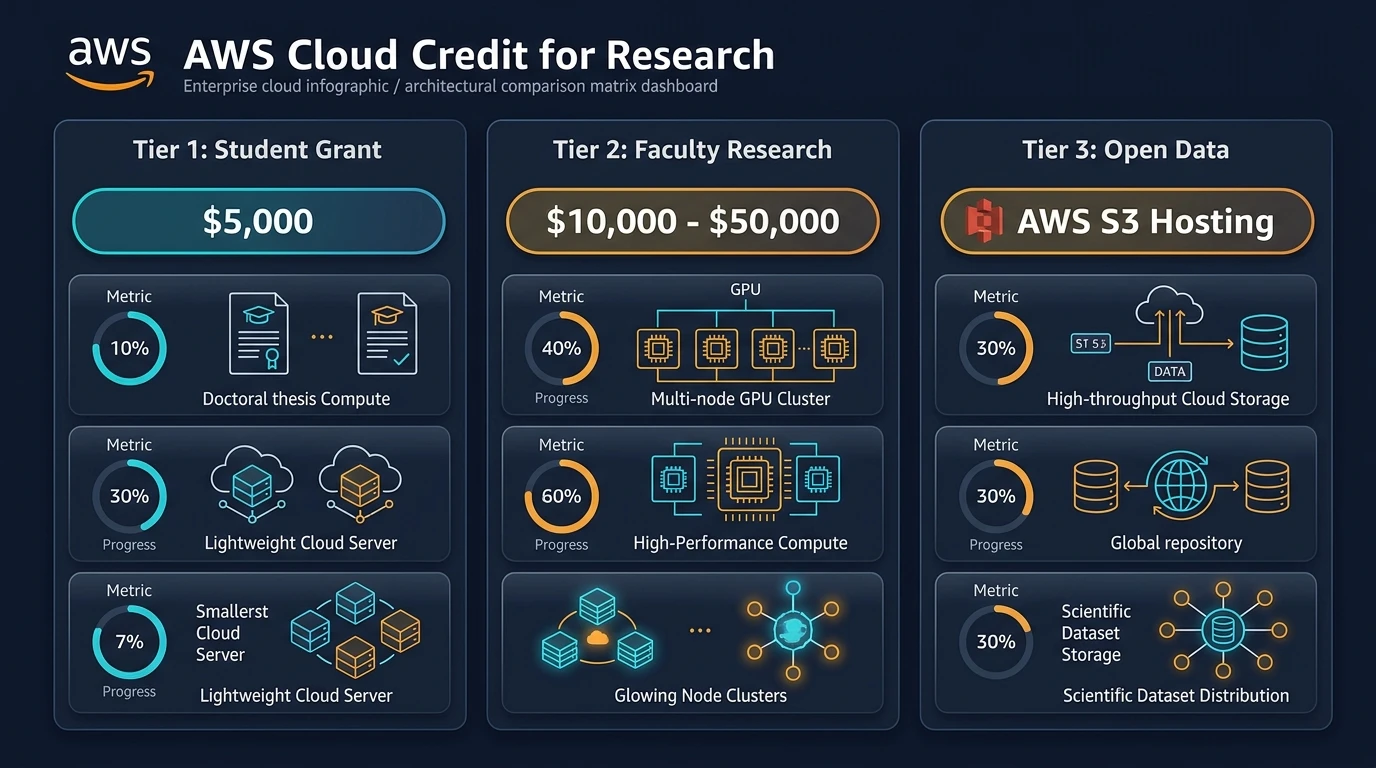
Unlike commercial startup credits provided through AWS Activate, academic research credits are awarded on merit through peer-reviewed technical proposals. Student projects can secure up to $5,000 in credits, while joint faculty proposals have no formal dollar cap. Examine the standardized grant tiers below:
| Grant Category | Maximum Credit Allocation | Eligible Research Scope & Deliverables |
|---|---|---|
| Student Research PI | Up to $5,000 USD | Undergraduate thesis, Master's capstone, and PhD dissertation computational research. |
| Faculty & Lab Research | $10,000 – $50,000+ | Multi-node GPU clusters, sponsored department research, and cross-university initiatives. |
| Coursework & Education | $500 – $1,500 USD | Classroom instruction, machine learning workshops, and student lab cohorts. |
| AWS Open Data Sponsorship | 100% S3 Covered | Public scientific dataset hosting with zero egress fees for open-access research. |
2. Step-by-Step Proposal Submission & 90-Day Review Protocol
AWS evaluates research credit applications on a rolling quarterly basis. Successful applicants follow this structured 4-step preparation protocol:
- Secure Faculty Sponsorship: While graduate and undergraduate students can author the technical proposal, AWS requires a permanent faculty member (professor or department chair with an active
.eduor.ac.ukemail) to serve as institutional co-signer. - Draft the 3-5 Page Technical Proposal: Detail your research hypothesis, computational methodology, specific AWS services required (e.g., EC2 G5 GPU clusters, SageMaker, Amazon Bedrock), and expected open-source outcomes or peer-reviewed publication venues.
- Build a Granular AWS Cost Estimate: Export an official estimate from the AWS Pricing Calculator detailing your hourly GPU instance usage, storage volume, and network egress requirements to substantiate the requested dollar amount.
- Submit via AWS Academic Portal: Submit the application package through Amazon's academic portal. Review typically spans 60 to 90 business days, after which credit promotional codes are provisioned directly to your dedicated AWS account.
3. Sizing NVIDIA GPU Compute & Amazon Bedrock Research Workloads
Allocating a $5,000 academic credit effectively requires balancing accelerated hardware instances against managed generative AI APIs. Graduate students training custom domain adapters or fine-tuning open-weights models typically divide their allowance across three primary compute vectors:
- EC2 G5 Instances (NVIDIA A10G 24GB): Ideal for fine-tuning 7B to 13B parameter language models and diffusion networks. At on-demand rates of ~$1.21/hr for
g5.xlarge, a $5,000 grant yields over 4,100 hours of continuous GPU runtime. - EC2 P4d / P5 Clusters (NVIDIA A100/H100): Reserved for large-scale distributed pre-training and massive multi-modal workloads. P4d instances can be provisioned through Faculty Tier grants for multi-node PyTorch DistributedDataParallel jobs.
- Amazon Bedrock Foundation Models: Access leading proprietary models including Anthropic Claude 3.5 Sonnet, Mistral Large, and Meta Llama 3.3. Student researchers can evaluate prompt engineering pipelines and benchmark synthetic datasets against high-capacity models without commercial billing.
4. Related Academic Developer Allowances & Synergies
Combine your AWS research compute grant with complementary university programs to create a comprehensive zero-cost academic developer environment:
Instant $100 compute grant with no credit card required, featuring Azure OpenAI Service access.
Student Developer Stack GitHub Student Developer Pack →Complimentary GitHub Copilot subscription ($120/yr value) and academic development tools.
Commercial Transition AWS Activate Startup Credits →Spin off academic research into a venture-backed startup with $1,000 to $100,000 in cloud credits.
Master Directory Free AI Credits Hub (152 Deals) →Explore 152 verified free AI credits, zero-card developer APIs, and cloud compute grants.
5. Frequently Asked Questions About AWS Research Credits
Can undergraduate students apply for AWS Research Credits directly?
Yes, undergraduate students are eligible for up to $5,000 in promotional credits for honors theses, capstones, and faculty-guided research, provided an accredited faculty member co-signs the application as the sponsor.
Does the AWS Research Credit grant require a personal credit card?
While standard AWS accounts require a credit card on file, institutional academic accounts linked through university research organizations can be provisioned through AWS Invoicing or designated educational billing profiles with zero student credit card exposure.
Can AWS research credits be applied to Amazon Bedrock models?
Yes. AWS promotional credit codes awarded through the Cloud Credit for Research program apply directly to eligible AWS service usage, including Amazon Bedrock model inference, EC2 GPU compute, SageMaker training jobs, and S3 storage.