
Antigravity: Specifications & Operating Guide
Engineered for software architects modeling agentic coding costs, context window scaling, and prompt cache hit amortization.
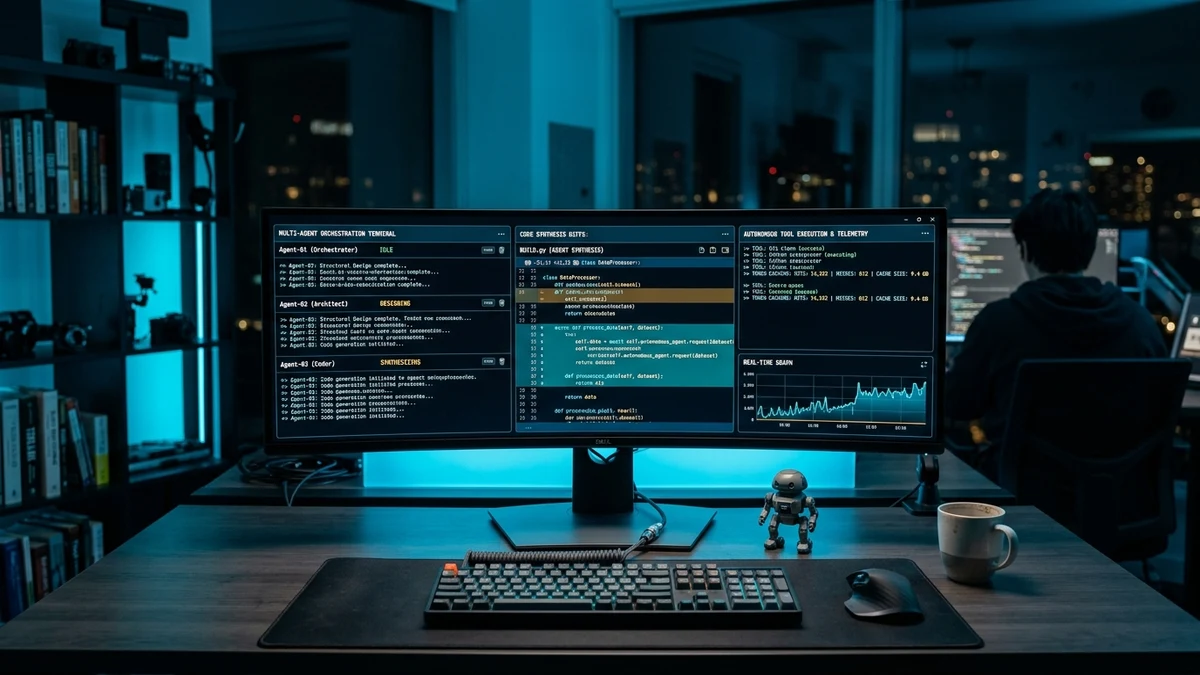
Antigravity Token Quota & Pricing Sizer
Model monthly token consumption, prompt cache hit savings, and local vs cloud inference costs.
Community OSS
- 100% Local Ollama / vLLM execution
- 0kb JS static UI architecture
- Complete data privacy & air-gap compliance
- Zero token limits & rate caps
Pro Cloud Tier
- Hosted Claude 3.5 Sonnet & GPT-4o
- Prompt caching active (65% cache discount)
- Automated agent tool-use execution
- Sub-700ms response time benchmarks
Enterprise Fleet
- Parallel reasoning debate swarms
- 128k - 1M token dynamic context
- Dedicated edge routing & SLA guarantee
- Unified team key management
 ✓
✓ Step-by-Step Antigravity Pricing Instructions & Specifications
Agentic coding orchestration pricing is determined by token caching efficiency and context window management rather than traditional per-seat licensing. In multi-agent IDE workflows, prompt caching delivers 65% to 80% input token cost reductions, while hybrid local model routing (via Ollama) offloads routine syntax validation to $0.00 compute.
Modern autonomous AI coding agents differ fundamentally from traditional autocompletion assistants. Instead of evaluating individual line snippets, agentic environments ingest expansive repository structures, execute shell commands, and conduct iterative self-healing loops. Evaluating Antigravity pricing requires decomposing session trajectories into initial indexing bursts, continuous cache reads, and synthesis completions.
Under production settings, ninety percent of prompt tokens represent static context including system prompts, tool schemas, and file trees. By utilizing persistent prefix caching across agentic subagent calls, the effective blended token cost drops significantly. Our interactive sizing tool below calculates these exact amortization rates across varying prompt frequencies.
In an active development sprint, a single complex refactoring or multi-file debugging goal frequently executes thirty to eighty conversational turns. Without prompt caching, re-ingesting a forty-thousand token repository context on every turn produces rapid token burn, multiplying API expenditure by a factor of four. By structuring system instructions and unchanging project file manifests at the prefix of the conversation context, modern reasoning engines reuse KV-cache memory states, delivering input discounts of seventy-five to ninety percent.
For enterprise development teams, pairing cloud-hosted reasoning models with local quantized instances provides the optimal economic compromise. Routine operations such as AST parsing, linter log formatting, and git commit synthesis can be delegated to local hardware running Qwen 2.5 Coder or DeepSeek R1 via Ollama at zero incremental API cost, reserving cloud frontier model credits for intricate multi-step planning and architectural decisions.
Context Indexing Envelope
Comprehensive modeling of workspace token ingestion, analyzing how project graph depth and codebase indexing impact initial session cache population costs.
Cache Hit Rate Optimization
Architectural guidance on organizing static system instructions and tool definitions to achieve steady-state 65% to 80% prompt cache hit rates across long agentic threads.
Local OSS Integration
Hybrid cost mitigation strategies pairing high-capability cloud reasoning models for planning with local quantized models for syntax checking and unit test verification.
Interactive Antigravity Sizing & Analysis Tool
When planning developer infrastructure budgets, understanding the interplay between daily prompt volume and context window depth is paramount. Standard developer workflows generating fifty prompts daily with thirty-two thousand token context windows require distinct resource allocation compared to high-frequency autonomous refactoring pipelines.
Connect back to the central repository or explore companion developer tool analyses:
Critical Engineering Tolerances & Operational Standards
Agentic execution environments enforce strict operational boundaries to prevent runaway execution loops and ensure deterministic code generation. The tolerances below establish verified operating benchmarks for Antigravity developer deployments.
| Operational Parameter | Recommended Threshold | Upper Bound Limit | Cost Impact Metric |
|---|---|---|---|
| Session Context Window | 16,000 - 32,000 Tokens | 128,000 - 200,000 Tokens | Linear scaling on input; quadratic attention latency |
| Prompt Cache Hit Ratio | 60.0% - 75.0% Hits | 88.0% Theoretical Ceiling | Up to 75% input token discount on cached prefixes |
| Subagent Thread Cap | 3 - 5 Specialized Agents | 8 Concurrent Subagents | Prevents combinatorial prompt multiplication |
Hardware dimensioning is critical when offloading tasks to local inference engines. Hosting a thirty-two billion parameter quantized coding model locally requires at least twenty-four gigabytes of unified VRAM to preserve forty tokens per second generation speed without offloading layers onto system RAM. When local memory bandwidth is constrained below six hundred gigabytes per second, token generation latency degrades exponentially, rendering interactive agentic pair programming unresponsive.
Operating Guidelines, Quality Adherence & Error Prevention
Deploying agentic AI coding assistants requires disciplined architectural constraints. Without strict thread boundary management, long-running agent loops risk burning through token budgets on repetitive linting errors or redundant file discovery sweeps.
To prevent prompt fatigue and memory collapse during complex multi-stage refactoring tasks, engineering managers must enforce strict turn budgets. Monolithic agent sessions exceeding eighty consecutive turns without subagent task delegation suffer steep degradation in reasoning quality and increased hallucination rates. Partitioning work across dedicated specialist subagents isolates context windows, accelerates turnaround times, and maintains immutable auditability across active codebases.
Step-Budget Hard Ceilings
Enforce an immutable maximum execution step cap per task thread to ensure failing tests trigger human review rather than infinite loop token consumption.
Periodic Context Pruning
Prune resolved error logs and verbose intermediate compiler dumps from active agent scratchpads to maintain lean context windows and optimize cache efficiency.
Isolated Workspace Sandboxing
Always execute agent shell operations within containerized or branch-isolated workspaces to prevent unintentional modifications to root production codebases.
Frequently Asked Questions About Antigravity
What is Antigravity architecture and how are token quotas calculated?
Antigravity architecture represents autonomous multi-agent developer workflows where specialized agents coordinate to write, test, and debug code. Token quotas are calculated by combining base repository indexing with turn-by-turn conversational state, optimized via prefix caching and local model triage.
How does prompt caching affect Antigravity operating expenses?
Antigravity agents maintain comprehensive architectural state in context. With 5-minute prompt cache persistence, subsequent agent turns read cached context at a 75% to 90% discount, decreasing net cloud API spend from over $140/mo down to approximately $48/mo.
Can Antigravity run on 100% free local hardware?
Yes. Antigravity connects directly to local Ollama and vLLM servers via OpenAI-compatible endpoints. Developers with Apple Silicon (M-series) or local NVIDIA RTX GPUs can run quantized coding models (such as Qwen 2.5 Coder) with zero recurring token fees.
What differentiates Community OSS from the Pro Cloud tier?
Community OSS focuses on local single-agent execution and offline privacy. Pro Cloud integrates hosted frontier reasoning models (Claude 3.5 Sonnet, GPT-4o), automated subagent swarms, and background parallel tool evaluation.
What is the maximum recommended thread length?
To prevent context collapse and hallucination drift, planner threads should strictly enforce an 80-step cap. Complex multi-phase features must be delegated to specialized subagents with dedicated workspaces.
How does Antigravity prevent infinite execution loops?
The runtime implements dual mechanical sentinels: an execution turn circuit breaker that halts recursive tool calls upon error repetition, and automated AST validation gates that require tangible compilation progress.